2026 / October
The new question is not whether the growth engine is running.
It is who finances its fuel, and at what price.
ECONOMY: THE TWO TRUTHS ARE NOW COLLIDING
In July, we argued that two apparently contradictory observations could both be true: corporate earnings and investment were resilient, while fiscal deficits, inflation and bond yields demanded caution. Three months later, neither side has disappeared. The AI investment cycle continues to support activity, but the cost of sustaining it is becoming a more visible market variable. This is an evolution of our July thesis, rather than a reversal.
The recent US inflation data illustrate the dilemma. September headline CPI increased 3.7% year on year, while core CPI stood at 2.6%. The gap matters: energy can revive headline inflation even when the underlying measure is appreciably softer. Yet repeated energy shocks can ultimately migrate into wages, transportation and business margins. The distinction between a one-off price shock and a durable inflation process remains critical. [1]
The October IMF Global Financial Stability Report describes resilient global markets alongside vulnerabilities from sovereign yields, leveraged AI exposures and cyber risk. That combination echoes the message of our July note: a fundamentally healthy economy does not guarantee forgiving asset prices. [2]
JULY: WHAT HAS BEEN CONFIRMED — AND WHAT HAS NOT
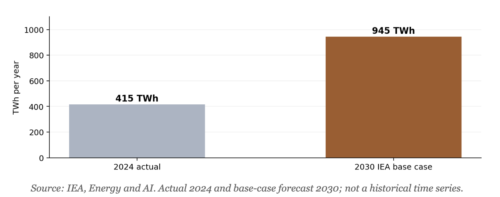
Our view that AI was increasingly a physical-infrastructure story has been reinforced. Power, cooling, grid access and financing are no longer peripheral issues. The IEA estimates data-centre power consumption at 415 TWh in 2024, rising to about 945 TWh by 2030 in its base case. [3]
Conversely, our July case for fixed-income quality has not yet been a straightforward directional rate call. Long yields can rise because of inflation and fiscal concerns, or fall abruptly when investors question the financing of AI and other risk assets. The recent switch in the market narrative from higher-yield anxiety to demand for government bonds during AI-related volatility demonstrates why the shape and quality of duration matter as much as its quantity. [4]
AI: FROM REVENUES TO THE CUSTOMER’S PROFIT AND LOSS ACCOUNT
A less discussed constraint is the ultimate customer. Every dollar of AI revenue is someone else’s expense. If enterprises pay a large share, productivity benefits must eventually offset higher technology bills or the cost will compress margins elsewhere in the economy. If consumers pay, adoption must compete with housing, healthcare and discretionary spending. If investment is funded predominantly with debt before monetisation develops, the financial burden migrates from shareholders to creditors.
The immediate warning indicators are therefore broader than semiconductor orders: hyperscaler free cash flow after capex, AI-infrastructure refinancing spreads, customers’ incremental software expense relative to savings, and the price paid per unit of AI computing. A sustained fall in unit pricing can coexist with strong demand and still challenge the economics of capital-intensive capacity.
AI can be economically transformative and still generate disappointing returns for some of those financing the transformation.
EQUITIES AND CREDIT: THE PRICE OF GOOD NEWS
The central equity risk remains one of valuation sensitivity rather than an inevitable collapse in profits. A narrow set of cash-generative firms can support the index while leaving it exposed to a change in discount rates.
A related development is the possibility of stress appearing first in specialised AI credit rather than broad high-yield indices. In October, the IMF highlighted the potential amplification from leveraged and concentrated AI exposures; reports on AI-infrastructure funding also point to a more discriminating credit market. This suggests watching issuer-level financing conditions as well as aggregate HY spreads. [2, 4]
COMMODITIES AND GEOPOLITICS: THE SECOND ROUND MATTERS
In July, we emphasised that disruption around Hormuz transmits through much more than crude oil. The same analytical framework remains relevant: LNG, fertilisers, sulphuric acid, chemicals and helium can affect food systems, industrial production and semiconductors. What matters for inflation is not just an energy-price spike but the duration of supply-chain disruption and its pass-through to final prices.
Copper has an equally nuanced role. Structural electrification and grid demand can support a long-term scarcity thesis, yet spot copper prices remain exposed to China, inventories, financial conditions and global manufacturing.
FIXED INCOME: THE CASE FOR QUALITY HAS BECOME MORE INTERESTING
In July we argued for stronger investment-grade exposure and intermediate government duration, without reaching indiscriminately for credit beta. That distinction still matters. Attractive all-in yields are not the same as attractive credit spreads: when spreads are tight, the investor is paid primarily for the underlying rate, not for absorbing a large deterioration in credit quality.
There is also a subtler cross-asset possibility. If the main market shock is renewed inflation, equities and long-duration bonds may decline together. If the shock is a sudden reduction in highly leveraged investment spending, government bonds can regain their diversifying role. The same nominal duration may therefore behave very differently across scenarios. Portfolio monitoring should distinguish total sensitivity.
OTHER RISKS AND OPPORTUNITIES: THE TRANSMISSION CHANNELS
Europe’s fiscal constraints, the UK’s sensitivity to inflation and China’s property adjustment are different manifestations of the same question: how quickly do financing costs and balance-sheet constraints reach companies and households? [8] An overlooked upside would be a recovery in activity without a corresponding resurgence in inflation. The US housing market offers a related example: lower mortgage rates could unlock transactions and associated spending even before house prices change materially. [7] These are potential transmission mechanisms, not forecasts of an imminent turn.
WHAT WE WOULD WATCH NEXT
The common thread is the transmission of risk through balance sheets and supply constraints. High public-market valuations need not unravel for higher funding costs, slow housing turnover or grid bottlenecks to affect activity. Equally, those frictions can create durable demand for infrastructure, selective credit provision and services that improve capital efficiency.
Key indicators include private-credit underwriting terms and refinancing activity, mortgage turnover, grid connection queues, Treasury term premium, corporate interest coverage and the spread between AI infrastructure spending and realized customer productivity gains.[6, 9, 10].
CONCLUSION: KEEP THE ENGINE, CHANGE THE TESTS
The July conclusion was “constructive, but less forgiving.” Our October conclusion is more conditional: growth and earnings are still important supports, but the durability of the cycle depends increasingly on the price of energy, the availability of capital and the real returns generated by AI adoption.
The Investment Committee approved a measured move toward neutral equity exposure and higher-quality fixed income.[5]. Any implementation for individual clients remains subject to their investment objectives, constraints and mandate.
OUR STANCE

Market resilience is not the absence of risk.
It is the ability to identify where the risk has moved.