
• Growth remained resilient, but the labour market and household purchasing power showed clearer signs of moderation.
• AI remained the dominant investment theme, but the debate shifted from adoption to financing and return on capital.
• The Fed delivered a hawkish hold, while Treasuries recovered as market stress shifted from inflation toward funding conditions and concentration.
October tested the funding behind the growth engine
Source: U.S. Bureau of Economic Analysis; FRED (PSAVERT); LFA visualization.
Growth remained strong, but the household cushion thinned
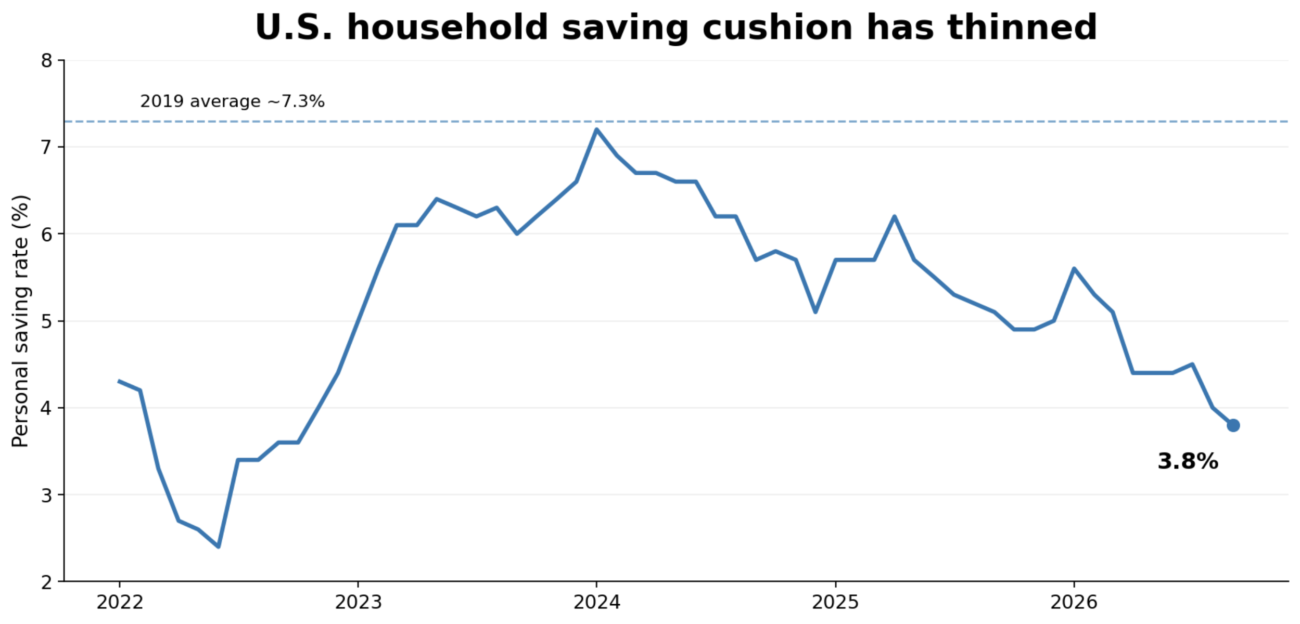
U.S. third-quarter GDP expanded at a 3.4% annualized rate, supported by consumption and business investment. Equipment investment was particularly strong, reflecting the continuing AI build-out. Yet September data released during October were less comfortable for households: real disposable income fell 0.3%, real consumption was essentially flat and the personal saving rate declined to 3.8%, from 4.5% in July. Growth therefore remained resilient, but consumers were using more of their income to sustain spending.
The market began to test the funding behind growth
October was not a uniform risk-off month. The pressure was concentrated in technology and other long-duration assets, while government bonds recovered late in the month. That dispersion mattered: investors were increasingly distinguishing between strong economic activity and the financing burden required to sustain the investment cycle.
AI: demand remained strong, but capital discipline became the test
Source: U.S. Treasury, Federal Reserve, ECB; LFA visualization.
AI moved from revenue growth to financing quality
The late-month technology sell-off was not caused by a collapse in AI demand. It followed earnings releases that confirmed very large spending commitments and forced investors to focus more closely on cash burn, depreciation, financing structures and the timing of returns. The Nasdaq fell 6.63% in October and the semiconductor index lost more than 15%, even as aggregate S&P 500 earnings remained strong.
The financing dimension became increasingly visible. S&P Global estimated that six major U.S. hyperscalers could spend more than $7 trillion on AI-related infrastructure between 2025 and 2030, while specialized operators increasingly rely on project finance, private credit and other off-balance-sheet structures. In the most leveraged parts of the ecosystem, financing costs rose sharply. This is consistent with the latest LFA Market Outlook: AI remains a genuine structural theme, but the relevant test is increasingly monetization, cash generation and the availability of capital rather than adoption alone.
Bonds changed their message
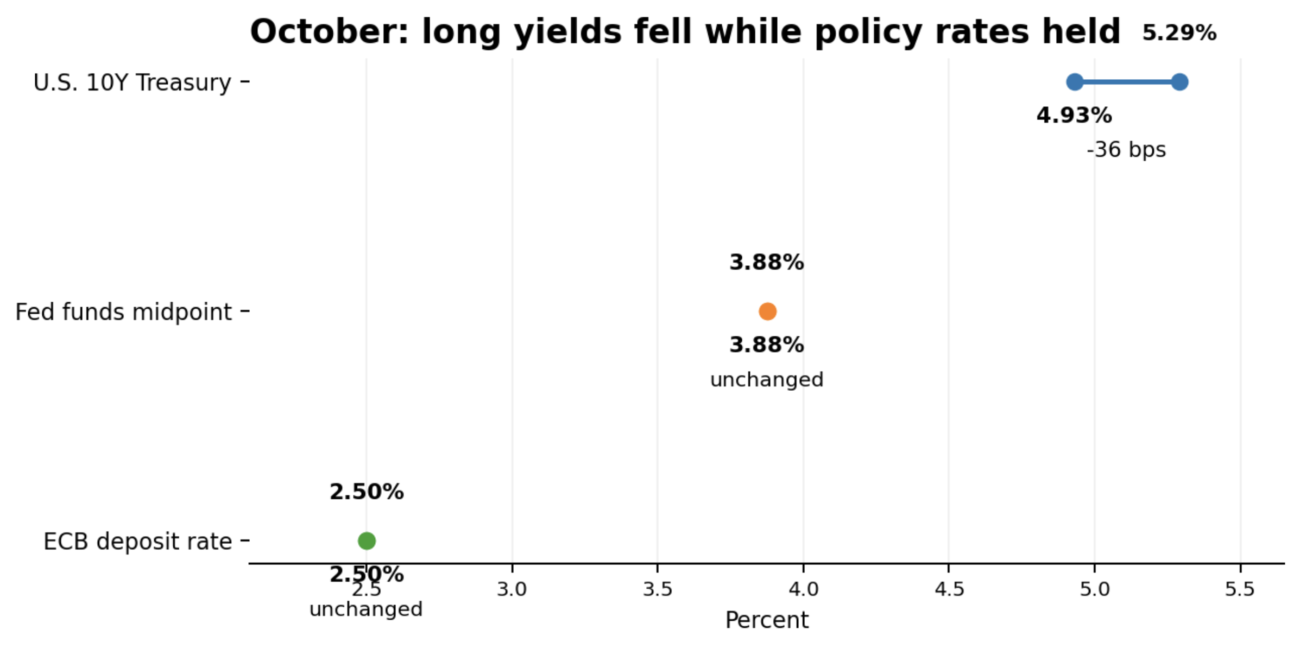
The U.S. 10-year Treasury yield fell from 5.29% at the end of September to 4.93% at the end of October. Earlier in the year, government bonds had been the source of stress as inflation, deficits and investment demand pushed yields higher. Late in October, Treasuries rallied as concerns shifted toward AI financing, equity concentration and the sustainability of capital spending.
This is not a reversal of the previous argument that high yields constrain risk assets. It shows that duration behaves differently depending on the shock: an inflation or fiscal shock can hurt equities and bonds together, while a funding or growth scare can restore part of government bonds’ traditional defensive role.
Oil: the downstream bottleneck mattered more than the headline
Energy remained volatile as the conflict around Iran and the Strait of Hormuz continued to distort global supply. By month-end, Asian crude imports had recovered close to pre-war levels as alternative suppliers and partially restored Gulf flows filled part of the gap. Refined products recovered much less: Asian imports of gasoline and middle distillates were still around 10% below pre-war averages, while Singapore gasoil and gasoline prices remained far above pre-conflict levels.
This reinforces a point made in previous commentaries: the economic impact of an energy shock is not captured by crude oil alone. Refining capacity, diesel, gasoline, LNG and other downstream products can remain constrained after crude flows normalise, keeping pressure on transport costs, inflation and industrial margins.
Europe: resilient earnings, but a higher cost of capital
The ECB kept its deposit rate unchanged at 2.5% after its September increase. European equities were more resilient than U.S. technology stocks and corporate earnings remained broadly supportive, but higher energy costs, tighter financing conditions and continuing fiscal concerns in France kept the regional picture uneven. The European story in October was therefore less about recession and more about the ability of different economies and sectors to absorb a higher cost of capital.
The Fed: a hawkish hold and a divided committee
On 28 October, the Federal Reserve left the federal funds target range unchanged at 3.75–4.00%, but the decision was a 10–2 vote rather than the unanimity seen at the September hike. Governor Lisa Cook and Cleveland Fed President Beth Hammack preferred another 25-basis-point increase. The statement also upgraded the description of economic activity from “solid” to “strong”, while repeating that inflation remains elevated. The message was therefore a pause in action, not a dovish change in direction.
Chair Kevin Warsh stressed that productivity gains may be raising the economy’s non-inflationary growth potential, but he offered limited forward guidance and did not rule out further tightening. The combination of strong growth, above-target inflation and internal dissent makes the Fed’s reaction function more data-dependent and less predictable. This reinforces a central point of the LFA Market Outlook: the monetary policy “put” is weaker when growth remains resilient and inflation is still above target.
Midterms: fiscal policy moves back into focus
The 3 November U.S. midterm elections will determine control of Congress for the final two years of President Trump’s term. For markets, the relevance goes beyond party politics. Congressional control can affect budget negotiations, the debt ceiling, tax and spending legislation, oversight of AI and data-centre investment, banking and crypto regulation, defence spending and trade policy. A divided government would make major legislation harder and could increase fiscal brinkmanship; unified control would offer greater policy continuity but would not by itself resolve the structural U.S. deficit. The market link is therefore mainly through fiscal credibility, Treasury supply and the regulatory framework around the investment cycle, rather than a simple directional equity call.
Sources: BEA, BLS, Federal Reserve, FRED, ECB, U.S. Treasury, Reuters, S&P Global, LFA analysis. Economic and market observations as of October 30, 2026; Fed decision as of October 28, 2026. Past performance does not guarantee future results.
Markets Performances
Markets
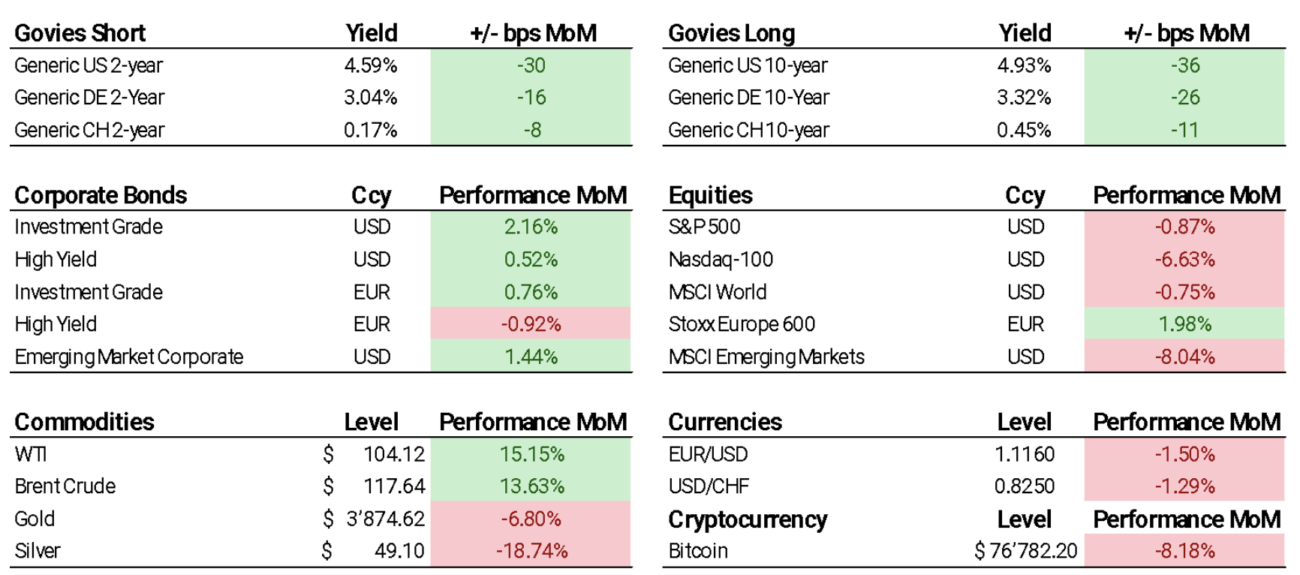
October saw weaker equity markets, particularly in the US and emerging markets, while European equities moved higher. Fixed income benefited from a broad decline in government bond yields. In commodities, oil prices rose sharply, while gold and silver recorded significant losses. The US dollar strengthened against the euro but weakened against the Swiss franc, while Bitcoin declined.
Equities
In the US, both the S&P 500 and the Nasdaq recorded losses, with technology stocks underperforming. European equities advanced, while emerging markets declined sharply.
Fixed Income
Government bond yields fell significantly in the US, Europe and Switzerland. Credit markets generally benefited, although performance was mixed across regions and segments, with euro-denominated high yield bonds recording negative returns.
Commodities
Oil prices rose sharply during the month, while gold and silver experienced a significant correction.
Currencies
The US dollar gained ground against the euro but weakened against the Swiss franc. Bitcoin recorded a significant negative performance.
Source: Bloomberg. Performance figures relate to the period 30/09/2026 to 30/10/2026. Past performance does not guarantee future results.
Performance Commentary
In October, the performance of the representative discretionary portfolio was modestly negative, as losses in equities and commodities outweighed the positive contribution from fixed income, while alternative investments had a broadly neutral impact.
Within fixed income, investment-grade securities provided the largest positive contribution, reflecting their sizeable allocation and gains across high-quality corporate issuers. Intermediate-maturity allocations were particularly supportive, as the portfolio’s intermediate duration profile benefited from the market environment while limiting exposure to more pronounced movements at the longer end of the yield curve. Emerging market bonds and preferred shares also contributed positively, with the latter generating more modest gains.
Equities were the main detractor from portfolio performance. North American holdings accounted for the largest negative contribution, led by broad US equity exposure and additional weakness in selected technology-related investments. The late-month correction in the technology sector also weighed on emerging market equities, highlighting the impact of the broader reassessment of highly valued growth-oriented companies. On the other hand, global equity exposures contributed positively, partially offsetting losses elsewhere within the asset class.
Finally, alternative investments were broadly unchanged overall, as the positive performance of listed private equity exposure was offset by weakness in long/short equity strategies. Commodities weighed on performance as well, with gold accounting for the largest negative contribution following its strong prior performance, while metals-linked exposure added to the decline.
Transactions
During October, we reduced equity exposure from overweight to neutral by trimming global equity positions. At the same time, we increased our allocation to investment-grade bonds, narrowing the fixed-income underweight while retaining an overall underweight position. This rebalancing aims to moderate portfolio risk and strengthen income generation through high-quality fixed-income investments, while maintaining equity participation at a neutral allocation. Of course, there is no assurance that these objectives will be achieved.
Disclaimer This material is for informational purposes only and does not constitute investment advice, a recommendation, or an offer to buy or sell any security. Past performance does not guarantee future results, and all investments involve risk, including potential loss of capital. Any forward-looking statements are inherently uncertain and subject to change. References to specific securities are for attribution only and should not be construed as a recommendation. Third-party data are believed to be reliable but are not guaranteed and may change without notice. Opinions expressed are those of Lugano Financial Advisors S.A. as of the date of publication and are subject to change without notice. Commentary on the discretionary portfolio relates to a representative account and is not indicative of the results of any individual client, which may differ due to fees, timing of investments, client-specific restrictions and other factors.