

- Global Economy is resilient, but markets do not forgive
- Inflation, Rates and Central Banks mistakes are the main drivers
- More dispersion is leading to more opportunities
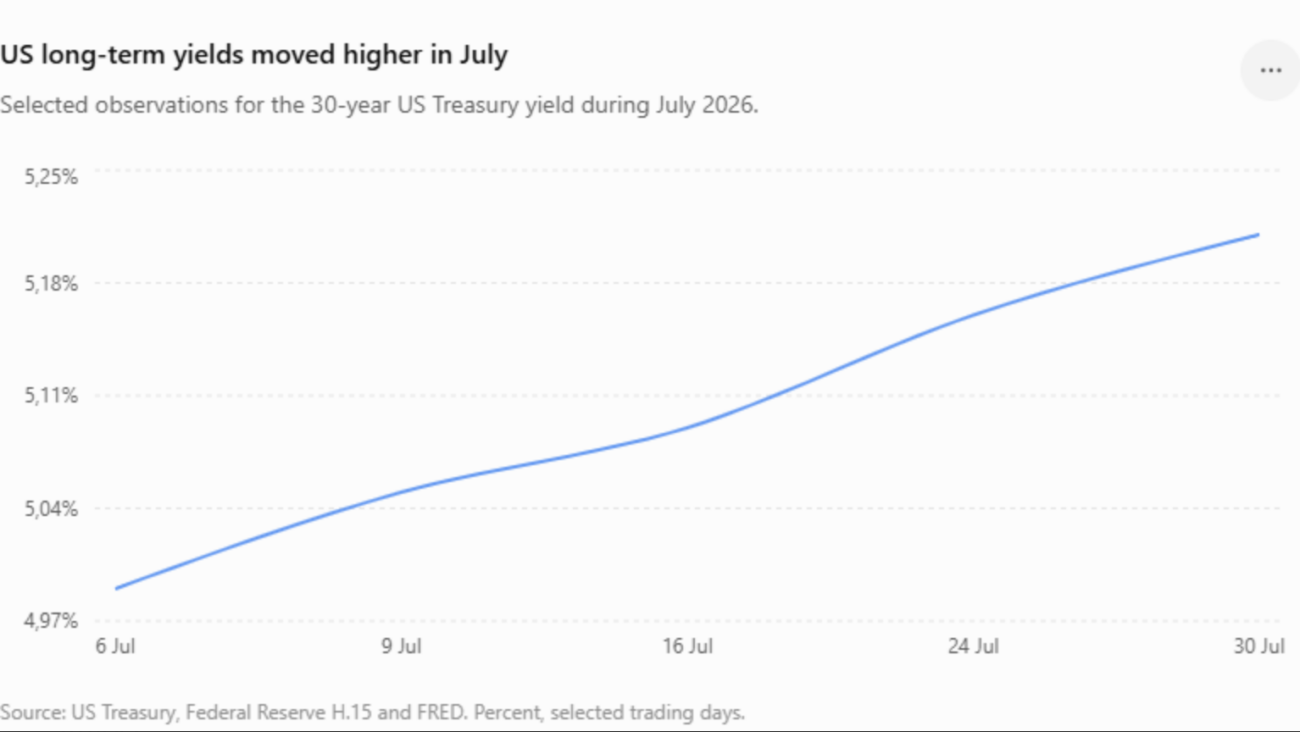
Resilient growth, less forgiving markets
July highlighted a growing divergence between a still-resilient global economy and increasingly demanding financial markets.
Economic activity remained positive, the US labor market did not point to an imminent recession, and corporate earnings were generally solid. However, renewed inflationary pressures, higher oil prices, rising long-term bond yields and greater scrutiny of artificial-intelligence investments reduced investors’ willingness to accept elevated valuations. The month was therefore less about a deterioration in economic fundamentals than about a repricing of risk.
Growth, inflation, and geopolitics converge
The US economy continued to expand, although momentum became less uniform. Employment growth slowed, while inflation remained above the Federal Reserve’s target and became more exposed to higher energy costs. The Fed kept its policy rate unchanged at 3.50%–3.75%, but its cautious message reduced expectations of near-term cuts. The most significant market reaction occurred at the long end of the yield curve. Thirty-year Treasury yields approached their highest levels in almost two decades, reflecting not only monetary-policy expectations but also persistent inflation uncertainty, heavy government issuance, and growing concerns over fiscal sustainability. Higher oil prices raised inflation expectations, constrained central-bank flexibility and weakened the outlook for consumers and energy-intensive companies. Europe faced a more difficult version of the same trade-off. Growth remained modest and the region’s dependence on imported energy increased its sensitivity to higher prices. The European Central Bank left rates unchanged, balancing the need to contain inflation against the risk of further weakening domestic demand. European equities nevertheless proved relatively resilient, helped by reasonable valuations and lower exposure to the most expensive areas of the technology sector.
Artificial intelligence: from broad enthusiasm to selective evidence
US equity indices concealed substantial differences between sectors and individual companies. Investors became more selective within the AI theme, even as demand for cloud services, computing capacity and data-center infrastructure remained exceptionally strong. The market is increasingly distinguishing between companies that can convert AI investment into recurring revenues and cash flow, and those committing large amounts of capital without yet demonstrating adequate returns. A related but less visible issue concerns the quality of technology earnings. Part of the recent increase in reported profits has been influenced by gains on stakes in private AI-related businesses. Such gains may be economically relevant, but they are less predictable than operating revenues and can reverse if private-market valuations decline. Aggregate earnings growth may therefore overstate the improvement in underlying cash generation.
Market structure and the amplification of risk
The sharp volatility experienced in parts of Asia also demonstrated how market structure can magnify fundamental developments. Concentrated indices, leveraged exchange-traded products and momentum-driven positioning can transform a reasonable long-term investment thesis into an unstable short-term trade. This is becoming increasingly relevant beyond Asia. Passive flows, options positioning and systematic strategies can affect the speed and intensity of market corrections, particularly in securities where ownership and expectations are highly concentrated.
Gold, currencies, and diversification
Gold remained volatile during the month. Geopolitical uncertainty, fiscal deterioration, and demand for real assets continued to support its strategic role, while higher real yields and temporary liquidity need limited short-term performance. The US dollar also remained firm, supported by attractive relative interest rates and demand for liquidity. Its strength, however, contributed to tighter global financial conditions, particularly for emerging-market economies and companies with dollar-denominated liabilities. Persistent weakness in the yen may eventually require stronger intervention by the Japanese authorities. To support their currency, they may need to mobilize dollar reserves, potentially adding another source of selling pressure on US government bonds.
Investment implications: dispersion becomes the opportunity
The most important consequence of the current environment is likely to be greater dispersion—between regions, sectors, companies and even different parts of the same capital structure. During periods dominated by abundant liquidity and falling discount rates, market returns tend to become broad and highly correlated. When inflation, fiscal risk and capital costs become more relevant, individual business models matter more. Companies with similar revenue growth can produce very different shareholder returns depending on their capital intensity, balance-sheet strength, pricing power and ability to generate free cash flow. Dispersion is also likely to increase within the AI ecosystem. Semiconductor producers, cloud platforms, data-center operators, software companies, and electricity suppliers participate in the same structural theme, but face different competitive dynamics and investment requirements. The winners may not necessarily be those with the fastest reported growth, but those able to earn returns above their rising cost of capital. The same principle applies across asset classes. Short- and intermediate-maturity bonds may offer attractive income without taking the fiscal and inflation risk embedded in very long maturities. European and Asian equities may benefit from lower valuations, but only where earnings quality and governance justify the discount. Commodity exposure can provide diversification, although results will vary considerably between energy, precious metals, and industrial resources. Greater dispersion therefore strengthens the case for active portfolio construction. Index-level performance may become less informative, while security selection, position sizing and risk control become more important. The objective is not simply to identify the correct macroeconomic scenario, but to understand which assets are already pricing it, which remain vulnerable and which can perform under several different outcomes.
July’s market behavior suggests that the next phase may reward selectivity more than broad directional exposure. A more demanding environment can create volatility, but it can also provide better entry points and a wider opportunity set for disciplined investors.
MARKETS PERFORMANCES
Markets
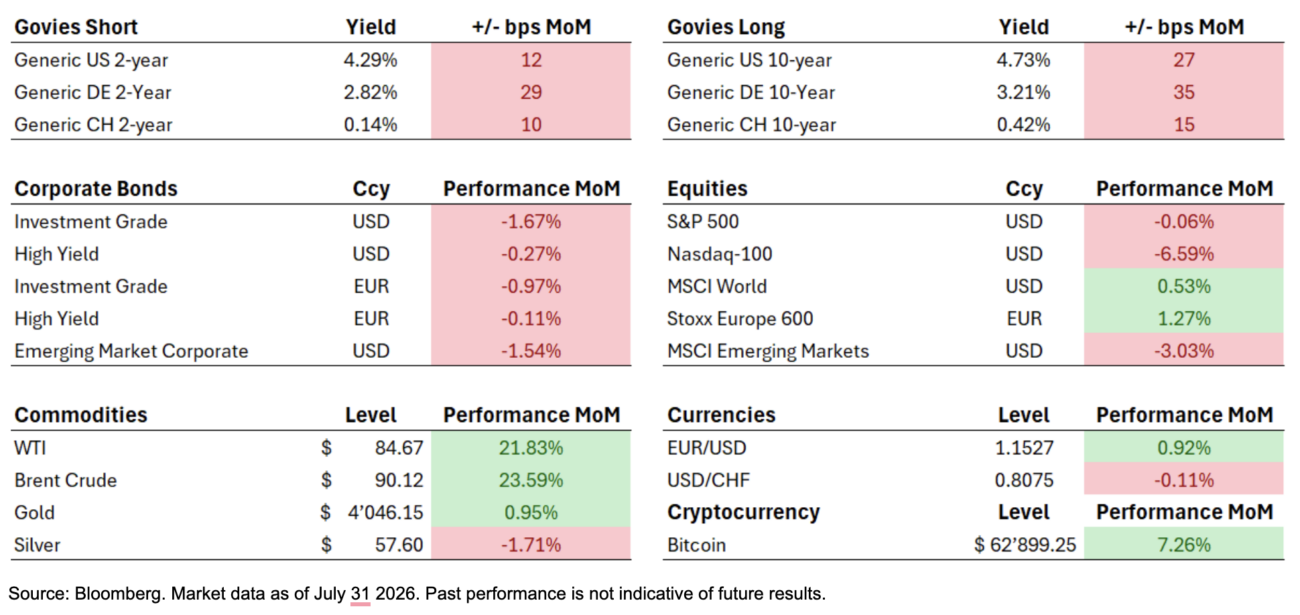
Financial markets ended July with mixed performances across asset classes. European equities outperformed U.S. markets, while higher energy prices and resilient economic data pushed government bond yields higher as investors reassessed the outlook for inflation and monetary policy. Commodities rallied strongly, led by oil prices amid geopolitical tensions.
Equities
Equity returns diverged across regions. European markets outperformed, supported by financials and cyclical sectors, while U.S. equities were weighed down by a sharp correction in large-cap technology stocks, driving the Nasdaq significantly lower. Emerging Markets also ended the month in negative territory, reflecting weaker sentiment toward Asian equities.
Fixed Income
Government bond yields rose across all major markets as investors reassessed the outlook for monetary policy amid resilient economic conditions and persistent inflation. Higher yields weighed on fixed income performance, with both investment grade and high yield corporate bonds recording negative monthly returns in the U.S. and Europe.
Commodities
Energy markets rallied strongly during the month, with both WTI and Brent crude gaining more than 20%, supported by supply concerns and geopolitical developments. Gold edged slightly higher, while silver ended the month modestly lower.
Currencies
The euro strengthened modestly against the U.S. dollar, while the Swiss franc appreciated slightly versus the dollar. Bitcoin rebounded during the month, posting a solid positive return.
Performance Commentary on Discretionary Portfolio
In July, portfolio positioning reflected a divergence across asset classes, with equities and alternative investments contributing positively, while fixed income faced headwinds from renewed upward pressure on interest rates.
More precisely, within the fixed income allocation, the persistent inflation concerns and a more restrictive interest-rate outlook pushed long-term bond yields higher, negatively affecting all the components of the sleeve.
Despite periods of volatility in AI-related stocks, equities remained a positive contributor during the period. Emerging Markets equities also contributed positively, supported by the portfolio’s diversified positioning and lower exposure to specific markets affected by the correction in AI-related sectors. Lastly, alternative investments performed positively too, confirming their diversification role within the portfolio, while commodities delivered smaller one mainly driven by the resilience in gold prices amid geopolitical uncertainty, finally adding to performance.
Transactions
During the period, the fixed-income allocation was adjusted by reducing exposure to high-yield and government bonds in favor of investment-grade securities. In addition, a new allocation to copper and aluminum was introduced within the commodities sleeve.
Disclaimer This material is for informational purposes only and does not constitute investment advice, a recommendation, or an offer to buy or sell any security. Past performance does not guarantee future results, and all investments involve risk, including potential loss of capital. Any forward-looking statements are inherently uncertain and subject to change. References to specific securities are for attribution only and should not be construed as a recommendation. Third-party data are believed to be reliable but are not guaranteed and may change without notice.