

- AI remains the key driver of equities, but leadership is becoming more selective.
- Hard assets are increasingly reflecting inflation, geopolitical and fiscal risks.
- Rising bond yields are emerging as the main constraint for risk assets.
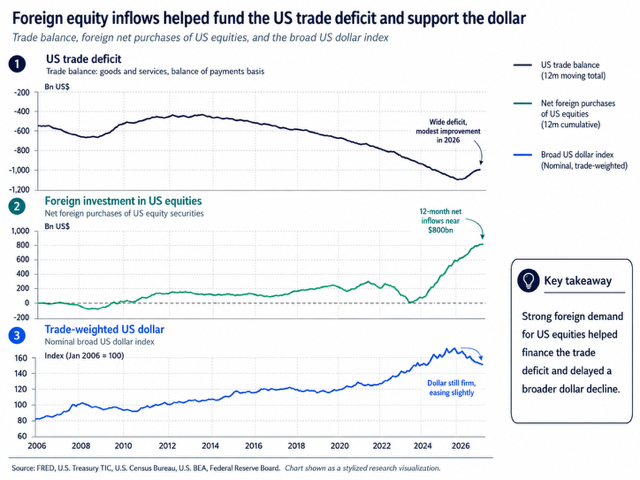
Foreign equity inflows helped fund the US trade deficit and support the dollar
Equities cheer, Commodities hedge, Bonds warn
August delivered positive returns across most risk assets, supported by resilient corporate earnings and continued enthusiasm around artificial intelligence. Yet beneath the positive headline performance, markets sent a less uniform message: equities remained constructive, commodities strengthened, while government bonds increasingly reflected concerns over inflation, fiscal sustainability and the cost of capital.
AI: From market theme to capital flow
Artificial intelligence remained the dominant equity theme, with technology and software among the strongest performers. However, investors are increasingly distinguishing between companies financing the AI investment cycle and those directly capturing its revenues.
More interestingly, AI is extending beyond equity markets. Strong foreign demand for U.S. technology stocks has helped finance the U.S. external deficit and support the dollar, suggesting that the AI investment cycle has also become relevant for international capital flows.
Hard assets send a different signal
Commodities were another major source of strength. Gold, Silver and energy-related assets advanced significantly, reflecting a combination of geopolitical uncertainty, fiscal concerns and renewed demand for real assets.
Energy markets deserve particular attention. While crude supply conditions improved during the month, inventories of refined products remained unusually tight. This suggests that headline oil prices may understate underlying inflationary pressure if constraints in gasoline, diesel and other refined products persist.
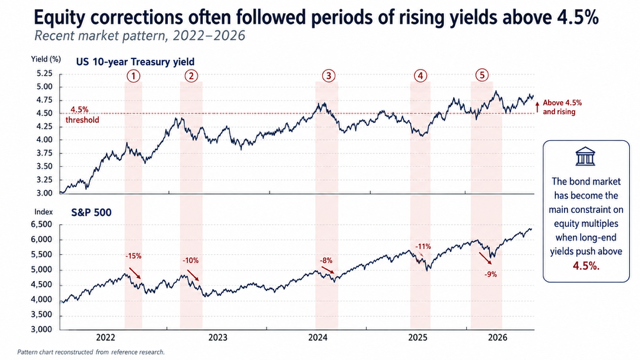
Historically, equity corrections often followed periods of rising yields above 4.5%; (see chart).
The Bond market is becoming the constraint
The most important risk signal came from government bonds. Persistent inflation, fiscal deficits, energy volatility, the scale of AI-related capital spending, and uncertainty over monetary policy pushed long-term yields higher, increasing the cost of capital for both governments and companies. The U.S. 10-year Treasury yield approached 4.8%, while long-term borrowing costs remained under pressure. The Federal Reserve’s message at Jackson Hole reinforced the point: policy may become less restrictive only if inflation continues to moderate, but the central bank is not ready to declare victory.
This matters because equities can generally absorb higher yields when they reflect stronger economic growth. The environment becomes more challenging when yields rise instead because of higher inflation, fiscal risk, or term premia.
Investment implications: Constructive, but increasingly yield-sensitive
The underlying environment remains constructive, supported by economic growth, healthy corporate earnings and the structural AI investment cycle. At the same time, strength in hard assets and pressure on long-term government bonds suggest that markets are increasingly pricing inflation, fiscal sustainability and currency-debasement risks. As long as yields remain contained, the equity cycle can continue; a persistent rise in the cost of capital would make markets considerably more selective.
Market performances
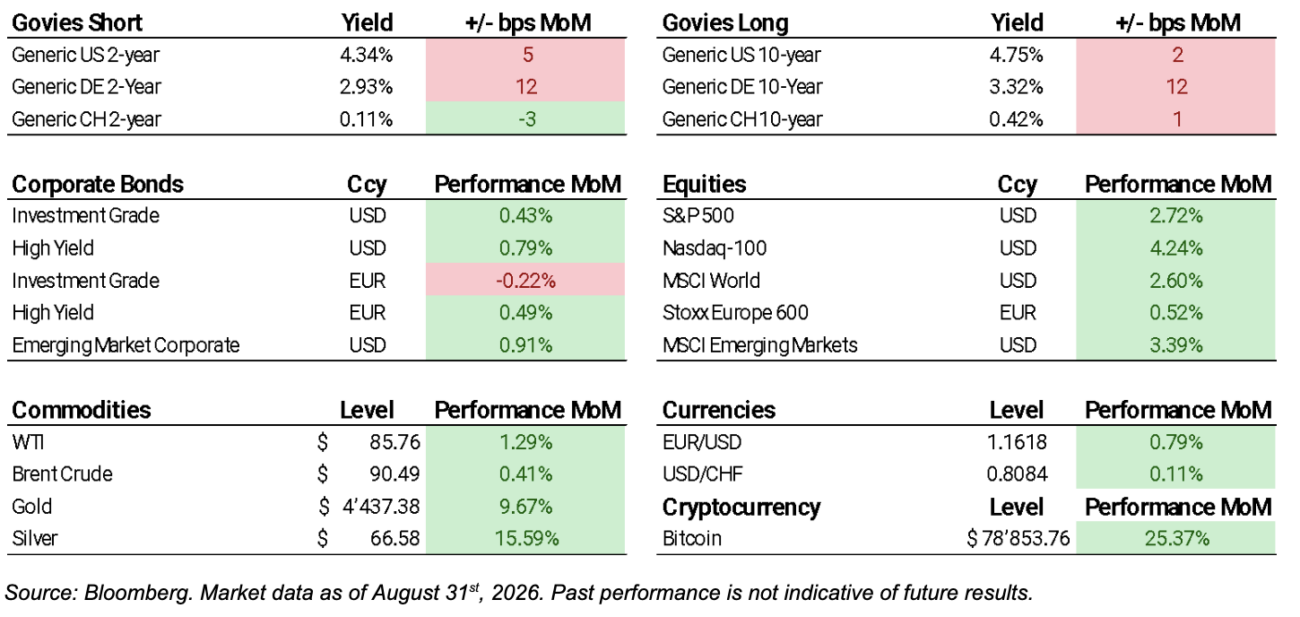
Financial markets ended August broadly higher. U.S. equities led gains, supported by technology and AI-related stocks, while European markets lagged amid higher bond yields and fiscal concerns. Fixed income performance was mixed: government yields increased, while tighter credit spreads supported corporate and emerging market bonds. Commodities strengthened, led by precious metals and energy, while the U.S. dollar weakened modestly and Bitcoin rallied strongly.
Performance Commentary on Discretionary Portfolios
Discretionary portfolios delivered positive returns in August, with equities and commodities providing the largest contributions.
Equities benefited primarily from North American exposure and the recovery in technology and growth stocks, while Emerging Market and global equities also contributed positively. Fixed income remained resilient despite rising government yields, supported by investment-grade credit, preferred securities and Emerging Market bonds.
Commodities provided another meaningful contribution, particularly through gold, while industrial metals added modestly. Alternative investments also generated a small positive return, mainly through hedge funds.
Transactions
No transactions were executed in the model portfolio during August.
Disclaimer This material is for informational purposes only and does not constitute investment advice, a recommendation, or an offer to buy or sell any security. Past performance does not guarantee future results, and all investments involve risk, including potential loss of capital. Any forward-looking statements are inherently uncertain and subject to change. References to specific securities are for attribution only and should not be construed as a recommendation. Third-party data are believed to be reliable but are not guaranteed and may change without notice.