
This is the first of a series I plan to write regularly, if not always monthly: a short note about something practical from our world — the world of clients holding and investing assets across borders. Sometimes a structure we’ve used. Sometimes an explanation of how something works. Always with numbers where they help, and an honest look at the trade-offs.
This first one is about a client who swapped a US credit line costing about 6.5% for a Swiss one priced at 1.5% — without selling a single share. That rate wasn’t free: currency, collateral and variable-rate risk came with it. More on that below.
Success created the constraint
After a few strong years in the public markets, this is a problem more and more of our clients are running into: a portfolio that’s grown nicely, and a debt attached to it that’s quietly gone from cheap to expensive without anyone quite noticing when it happened. The markets were doing well enough that it didn’t seem to matter; until it did.
One client’s version of it looked like this. Several long-held equity positions had appreciated substantially. The portfolio was worth about USD 4 million, with an estimated tax basis of USD 1.2 million. In other words, approximately USD 2.8 million of the value represented unrealised gains.
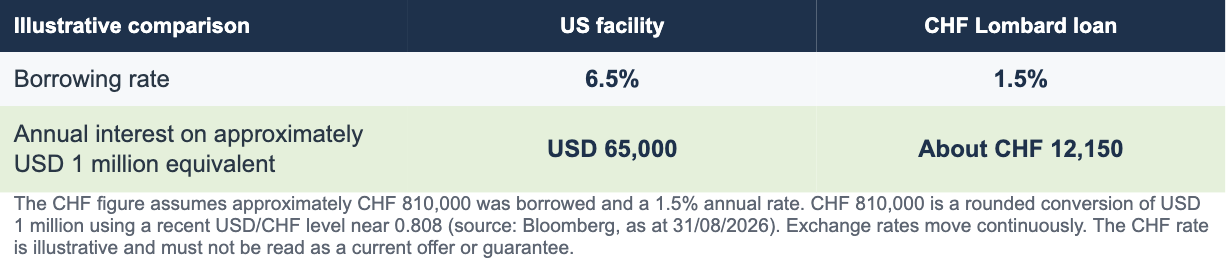
The client also had a USD 1 million US securities-backed credit facility. The proceeds had been invested in public equities under the terms of that facility. The line had been opened years earlier, when short-term rates were close to zero, and simply left to roll over since. As the Fed tightened, the rate climbed with it — but the portfolio was compounding nicely enough that the interest felt more like background noise than a real cost. By the time we reviewed it, the rate was approximately 6.5%, or about USD 65,000 of annual interest if the balance remained unchanged; suddenly, it mattered. The client wasn’t in any trouble. There was simply no longer a good reason to keep paying that much.
A rate around 6.5% is a reasonable illustration, not a quotation — actual pricing depends on the lender, collateral and facility size.

Why not simply sell and repay the loan?
The obvious answer: sell some stock, repay the loan. Simple enough — except the tax basis made that expensive.
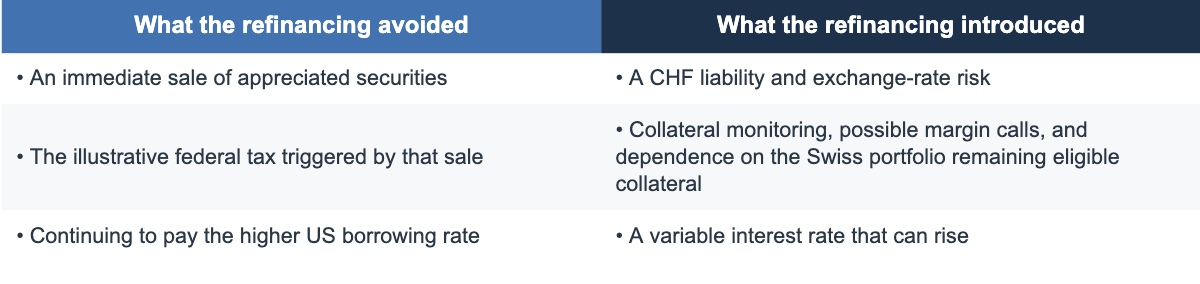
We’ve simplified the arithmetic here rather than walk through the full tax calculation: the bottom line is that liquidating enough of the portfolio to repay the USD 1 million loan would trigger a federal tax bill of roughly USD 200,000, before any state tax — illustrative only, and not tax advice.
The point isn’t that selling was off the table — it’s that doing so wasn’t free.
The goal was cheaper financing. Not a tax bill.
The Swiss alternative
So what other route was there?
The client already had a diversified portfolio with a Swiss custodian bank — which meant another option: pledge eligible Swiss assets for a Lombard loan in francs, convert the proceeds to dollars, and repay the US facility.
A Lombard loan is simply a bank loan secured by an investment portfolio. The bank doesn’t lend against every asset at full value — it assigns a lending value to eligible assets and monitors the collateral over time.
That monitoring is what creates the margin-call risk noted below: the bank assigns the Swiss portfolio a lending value — a percentage of its market value — and if that lending value ever falls below the outstanding loan, the bank will ask for more collateral or partial repayment. We haven’t set out this client’s specific cushion — it depends on the underlying holdings — but the principle is simple: the bigger the gap between what’s borrowed and what could be, the more room there is before that call arrives.

The annual interest difference
At the starting exchange rate, the CHF 12,150 Swiss interest cost was equivalent to roughly USD 15,000 — versus USD 65,000 on the US facility, an initial difference of approximately USD 50,000.
That’s a dramatic reduction in the stated rate, from 6.5% to 1.5% — but not a risk-free saving. Measured in US dollars, the result will move with the USD/CHF exchange rate, since both principal and interest are in Swiss francs.
One thing does make this easier to live with day to day: the Swiss portfolio held income-generating positions, and the resulting CHF dividends were enough to cover the CHF interest. In practice, that meant the loan could be serviced out of the portfolio’s own income, without needing to convert currency each quarter to make the payment. That doesn’t change the point above, though — the CHF liability itself, translated back into dollars, still moves with the exchange rate. Comfortable debt service today says nothing about what the principal is worth tomorrow.
What the client avoided, and what the client accepted
The lesson
The client’s successful investments were not the problem. The financing attached to them had become expensive — not because anything had gone wrong, but because it had quietly stopped making sense.
Most portfolio conversations focus on what to own. This one was different: the more useful question was whether the liability could be improved without disturbing the assets that created it.
The answer was conditional, not universal. A CHF Lombard loan was attractive because the client already had suitable collateral in Switzerland, could tolerate currency movements, and was comfortable with the possibility of a margin call without it forcing a sale. Another client could reach a different conclusion.
Sometimes the most effective balance sheet change is not to sell a successful investment. It is to reconsider how the borrowing is financed.
Hopefully that illustrates the idea.
Whether something like this fits your situation depends on your own accounts, your tax position, and how much currency and collateral risk you’re comfortable carrying — this note is not a recommendation. But if you’d like to talk through whether it’s worth a closer look, get in touch.
Until next time,
Paolo Panza, CFA
CEO, LFA
Disclaimer: This communication is for informational purposes only and does not constitute investment advice or a recommendation to buy or sell any security. References to specific strategies, securities or currencies are illustrative only. Views expressed are those of LFA SA as of the date of publication and are subject to change. Investments involving foreign currencies, including the Swiss franc, carry additional risks such as currency fluctuation and differing regulatory environments, which may result in gains or losses independent of the underlying investment’s performance. Past performance is not indicative of future results; investing involves risk, including possible loss of principal. LFA SA is an SEC-registered investment adviser and is regulated by FINMA in Switzerland; registration does not imply a certain level of skill and is not an endorsement by the SEC or FINMA. Please refer to our Form ADV for a full description of our services, fees, conflicts of interest, and risks.