

- The bond market moved from warning signal to the main market driver.
- AI remained the growth engine, but financing and depreciation costs became harder to ignore.
- Oil returned as an inflation and interest-rate story, not simply a growth shock.
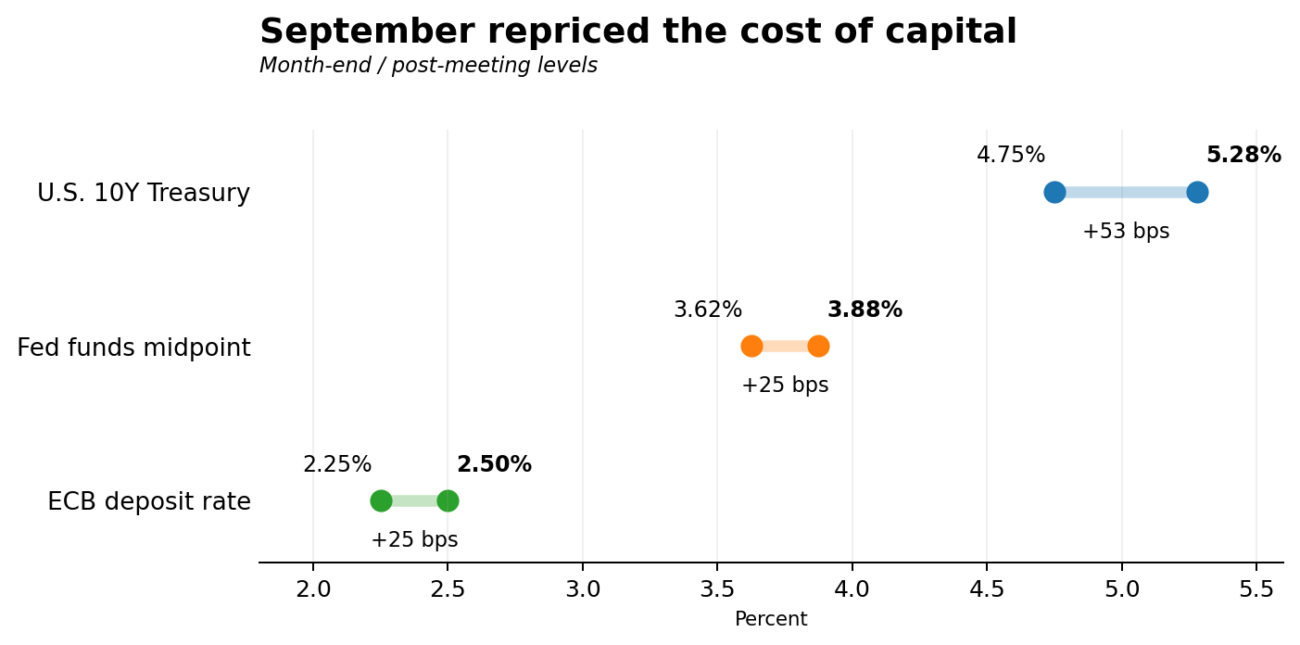
Source: Federal Reserve, ECB, Reuters; LFA calculations.
Growth held up. The cost of capital rose.
September did not bring a major deterioration in economic activity. U.S. growth, employment and consumer spending remained resilient. What changed was the price of money: government bond yields rose sharply as investors absorbed stronger growth, persistent inflation, large public borrowing needs and a renewed energy shock.
The Bond market takes centre stage
The Federal Reserve and the ECB both raised policy rates by 25 basis points. The U.S. 10-year Treasury yield rose by 53 basis points during the month – its largest monthly increase since 2022 – while European sovereign yields also moved higher. The key message was not recession, but a higher hurdle rate for capital.
This was an important evolution from August. The bond market had already become the main warning signal; in September it became the market variable against which equities, credit and new investment had to be assessed.
Why this matters
A large part of the rise in yields came through real rates rather than a disorderly jump in inflation expectations. September therefore sharpened the tension between a still-healthy economy and a materially higher cost of capital.
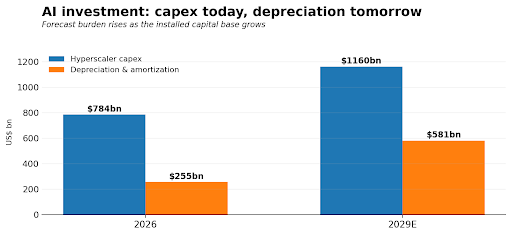
Source: BCA Research, Bloomberg Finance L.P.; LFA visualization
AI is becoming a fixed-income story
Artificial intelligence remained the strongest structural theme in markets. Demand indicators were still robust: GPU rental rates remained firm, memory prices rose and adoption continued to expand. But September pushed a different question to the foreground: who will finance the investment cycle, and at what cost?
BCA estimates that hyperscaler capital expenditure could reach about $1.4 trillion annually by the end of the decade, including off-balance-sheet investment. Depreciation charges are projected to rise from roughly $255 billion in 2026 to $581 billion in 2029.
That creates an accounting asymmetry. Suppliers recognise much of the revenue and profit today, while buyers capitalise the investment and recognise the cost gradually through depreciation. The AI boom can therefore support current earnings while part of its economic cost appears only later.
From growth story to return-on-capital story
According to BCA Research, the global AI industry could eventually need around $10 trillion of annual revenue to justify the capital being deployed – roughly comparable with annual global spending on food or healthcare. This is not a forecast; we believe it is a useful way to frame the scale of the investment cycle.
The financing dimension also became more visible. AI investment is supporting growth and earnings, but the same buildout is increasing demand for capital. The AI boom and the bond sell-off are increasingly part of the same story.
Oil: the transmission mechanism matters
Brent crude gained about 14% during September as Middle East tensions kept the geopolitical risk premium elevated. The macro impact differs from the classic oil shocks of the 1970s because U.S. household energy spending is a much smaller share of income.
The transmission instead ran visibly through inflation expectations, central-bank policy and long-term yields. Gold illustrated the point: despite geopolitical uncertainty, it fell about 6.3% as higher real yields and a stronger dollar outweighed safe-haven demand.
MARKET PERFORMANCE
Markets
Financial markets closed September with mixed performance across asset classes. Equities showed divergent trends across the main regions, while fixed income recorded negative performance. Among commodities, oil prices rose sharply, while gold and silver corrected. The US dollar strengthened, while Bitcoin recorded a positive performance.
Equities
In the US, the Nasdaq-100 recorded strong gains, while the S&P 500 closed the month slightly lower. Major European indices declined, as did emerging markets.
Fixed Income
Government bond yields rose significantly in both the US and Europe. The move also weighed on credit markets, with spreads widening across both investment grade and high yield segments.
Commodities
Oil prices rose sharply during the month, while gold and silver experienced a significant correction.
Currencies
The US dollar gained ground against both the euro and the Swiss franc. Bitcoin recorded a positive performance.
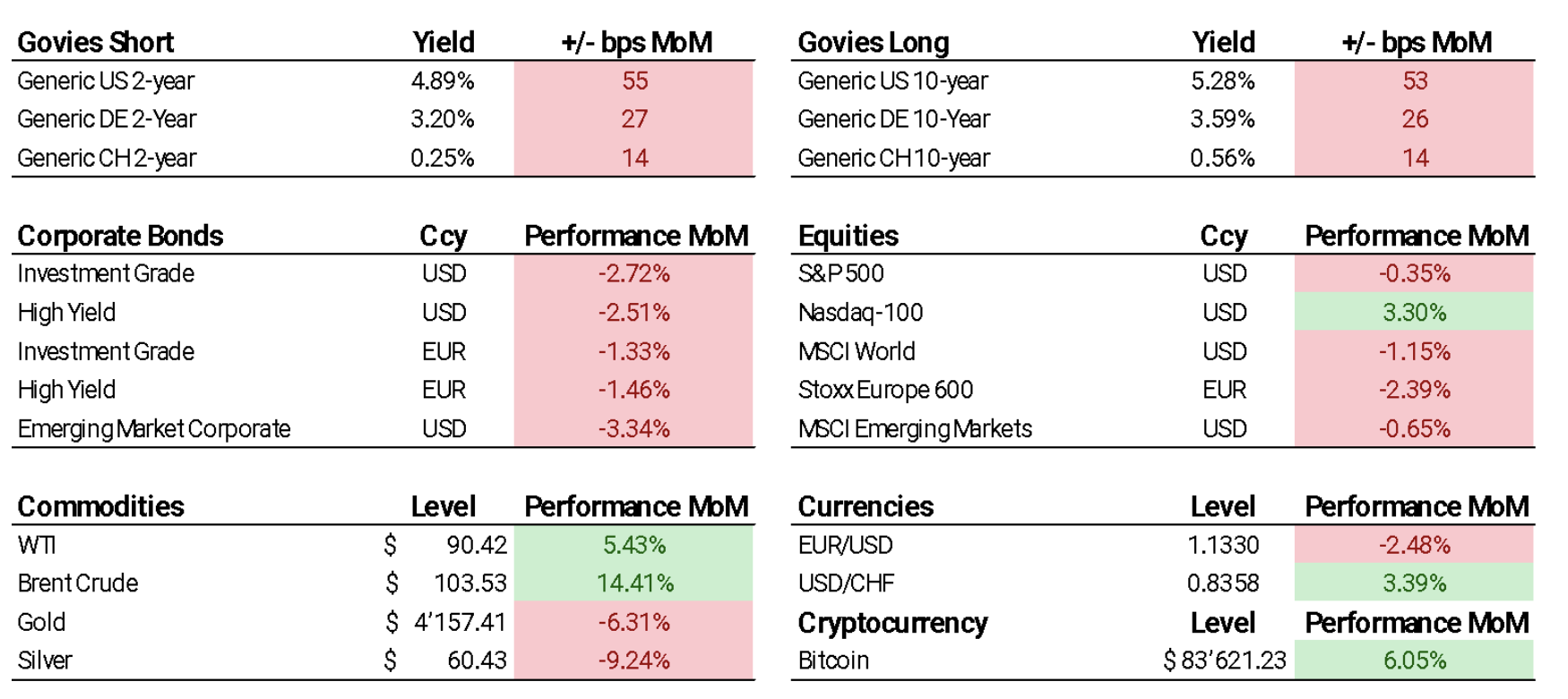
Source: Bloomberg Finance L.P. Data as of 30 September 2026. Index returns are calculated on a total return basis in local currency.
Performance Commentary on Discretionary Portfolio
In September, the performance of our representative discretionary portfolio was modestly negative, as losses in fixed income, alternative investments and commodities outweighed the positive contribution from equities. North American holdings provided the main support, partially cushioning weakness elsewhere in the portfolio.
Within fixed income, investment-grade securities were the largest detractor, reflecting their sizeable allocation. Emerging market bonds also declined, while preferred shares had a smaller negative impact. This weakness occurred against a challenging market backdrop, with renewed inflation concerns and rising Treasury yields weighing on bond valuations as investors reassessed the prospect of interest rates remaining elevated.
Equities contributed positively overall, led by North American holdings, while emerging market and global equity allocations detracted from performance, partially offsetting the gains. This divergence occurred alongside uneven US equity-market performance, with technology-oriented equities proving more resilient than the broader market.
Finally, alternative investments made a negative contribution led by losses in hedge funds, while commodities detracted as well primarily through gold, whose decline coincided with rising Treasury yields and a firmer US dollar, generating a mix that created a less supportive backdrop for non-interest-bearing assets. Nevertheless, metals had a smaller negative impact.
Transactions
During September, the portfolio increased its exposure to investment-grade bonds through a medium-duration issue. This investment aims to moderate portfolio risk and achieve a more balanced asset allocation while seeking to benefit from current fixed-income yield levels. In our assessment, the selected bond offers favorable relative valuation with a maturity that keeps the portfolio’s duration exposure contained. There is no assurance that these objectives will be achieved.